
Mines casino game guides
Guides to Casino Mines Games
Casino Mines games revolve around a choice: reveal another hidden tile or collect the amount available so far. A safe selection can increase the payout; a mine can end the round and cost you your wager. The rules depend on the version. For example, Stake’s Mines description explains this choice for its own game.
These Mines casino game guides help you identify the game and provider, then choose the question you want to answer: how a round works, what the odds mean, or how a result can be checked.
01 / Identify the game
Start with the exact game
A familiar name does not identify the rules on its own. Stake Originals Mines uses a 5×5 grid. Minesweeper by BGaming involves moving across a field in successive steps. Both involve avoiding mines, but a walkthrough for one will not explain the other’s controls.
Use the Mines games by provider catalogue to match the title before reading its rules. Look for the provider in the game’s information panel. Keep that name alongside the title when choosing a guide. Also distinguish the company that makes the game from the casino offering it: an operator’s account or payment terms answer a different question from the game’s rules.
02 / Find your question
Choose what you want to understand
| Your question | What to look for |
|---|---|
| What kind of Mines game is this? | A version overview identifying the provider, the layout and the way a round progresses. |
| What do I do during a round? | A rules guide matching the controls in your version, including what ends the round and when you can collect. |
| How likely is a safe pick? | A probability explanation stating the number of tiles, the number of mines and any assumptions about their placement. |
| What does the multiplier pay? | The game’s payout rules, including whether the displayed amount includes your original wager. |
| Can I check a completed result? | The verification instructions for that game’s fairness system and the records they require. |
If you are new to casino Mines, begin with the version and rules, such as how to play SPRIBE Mines. If you already know the controls, focus on the difference between the chance of continuing safely and the amount paid when you stop.
03 / Understand the numbers
Put the odds in context
Consider an illustrative board with 25 tiles and five mines placed uniformly at random. Before any tile is revealed, 20 of the 25 are safe, so one selection has an 80% chance of avoiding a mine.
The Mines probability guide explains the calculation, and the Mines signal bot calculator lets you compare one to four picks. That figure describes one selection. It does not identify a safe square or give the chance of completing a longer sequence. It also does not tell you the payout: that requires the rules of the particular game.
Fairness verification answers another question. In Stake’s documented system, the server seed is concealed before play and revealed when the player rotates it. The disclosed data supports checking earlier results; the process is not a preview of hidden tiles in an active round. Other games require their own documentation.
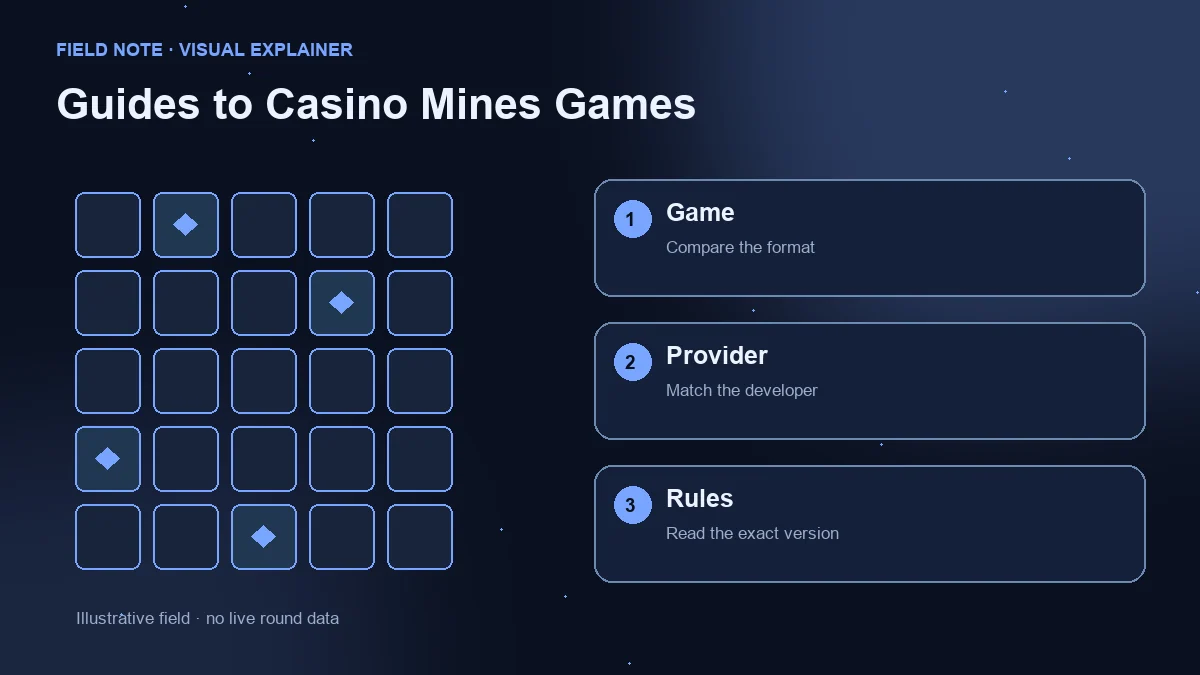
Illustrative board
04 / Check your location
Check the context for Canada
Check the operator’s location and age requirements separately from the game mechanics. For example, OLG’s Mines page specifies Ontario and an age requirement of 19 or older for online casino gaming. Those conditions should not be treated as a Canada-wide rule or as evidence about another operator.
Before wagering, decide how much time and money you are prepared to spend. A rules explanation or an odds calculation cannot guarantee a winning session.
05 / Read the sources
How this guide is sourced
The examples here come from the linked game-provider and operator documentation. The probability example is an illustrative calculation with stated assumptions. These sources explain the examples; they do not establish hands-on testing, withdrawal experience or access from every Canadian province.
Find your guide
Explore the Mines guides
Find game versions, casino context and clear explanations of the maths behind Mines.
Editorial credits
Who wrote and edited this page

Andrew Sortie
Author credited on the English source guides and their Russian editions; this credit does not imply that he translated them.
Edward M.
English-language editor. His public Upwork profile describes iGaming copywriting across casino and sports betting.
From the guides
Editorial notes
Clarifications on game versions, probabilities and verification.