
Probability tool
Mines Signal Bot
This Mines signal bot is a web calculator for a board described by rows, columns and a mine count. It shows the chance that the first one, two, three or four picks are all safe, plus the chance of the next safe pick if earlier picks were safe. It cannot read your game board or identify which tile to open.
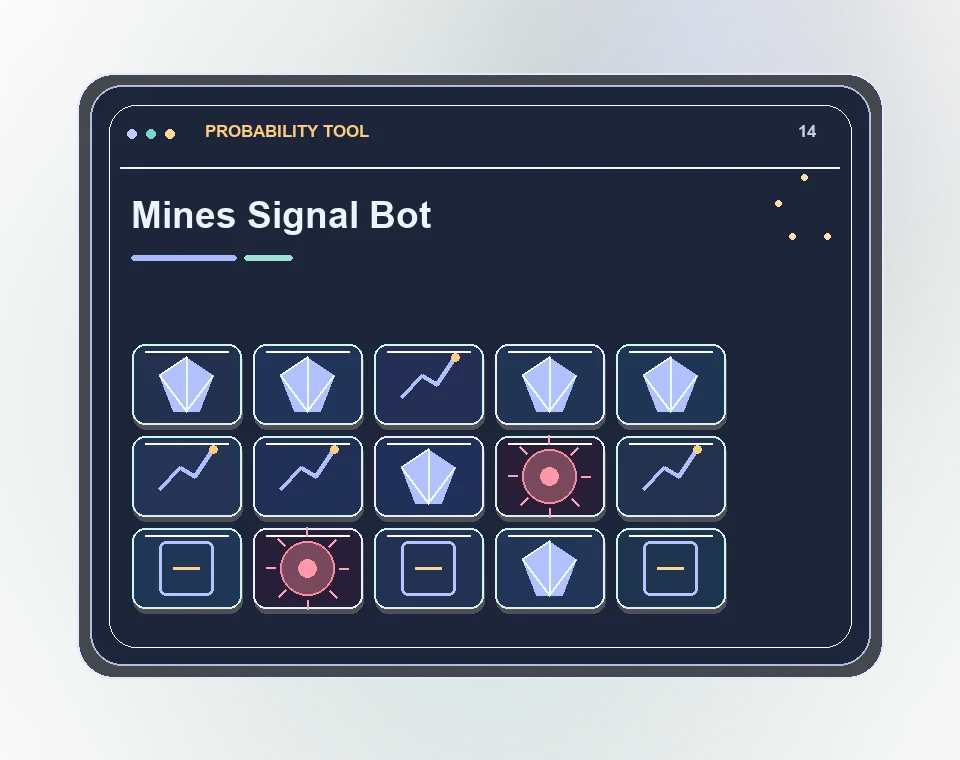
Interactive calculator
Safe-pick probabilities
Enter a board size and mine count to calculate the chance of one to four safe picks without replacement. The model assumes a fixed number of mines placed uniformly before the first reveal. This tool does not read a casino round or identify a safe tile.
Example result: 5 × 5 with 5 mines
- Safe cells
- 20
- Total cells
- 25
- Mines
- 5
Formula: (25 − 5) ÷ 25 = 20/25 = 80%
Chances for 1–4 safe picks
“All safe from start” is the chance that every pick in the series avoids a mine. “Next safe” assumes the earlier picks in that row were safe. Neither column identifies a safe tile in a live round.
| Pick | All safe from start | Next safe if prior picks were safe |
|---|---|---|
| 1 | 80% | 80% |
| 2 | 63.33% | 79.17% |
| 3 | 49.57% | 78.26% |
| 4 | 38.3% | 77.27% |
P(all first k safe) multiplies the safe fraction at each pick; P(next safe) uses only the remaining cells after earlier safe picks. “No tile” means the board is smaller than that pick number; “Not reachable” means the required earlier safe streak is impossible.
✓ Example safe cell× Example mine
How the calculation works
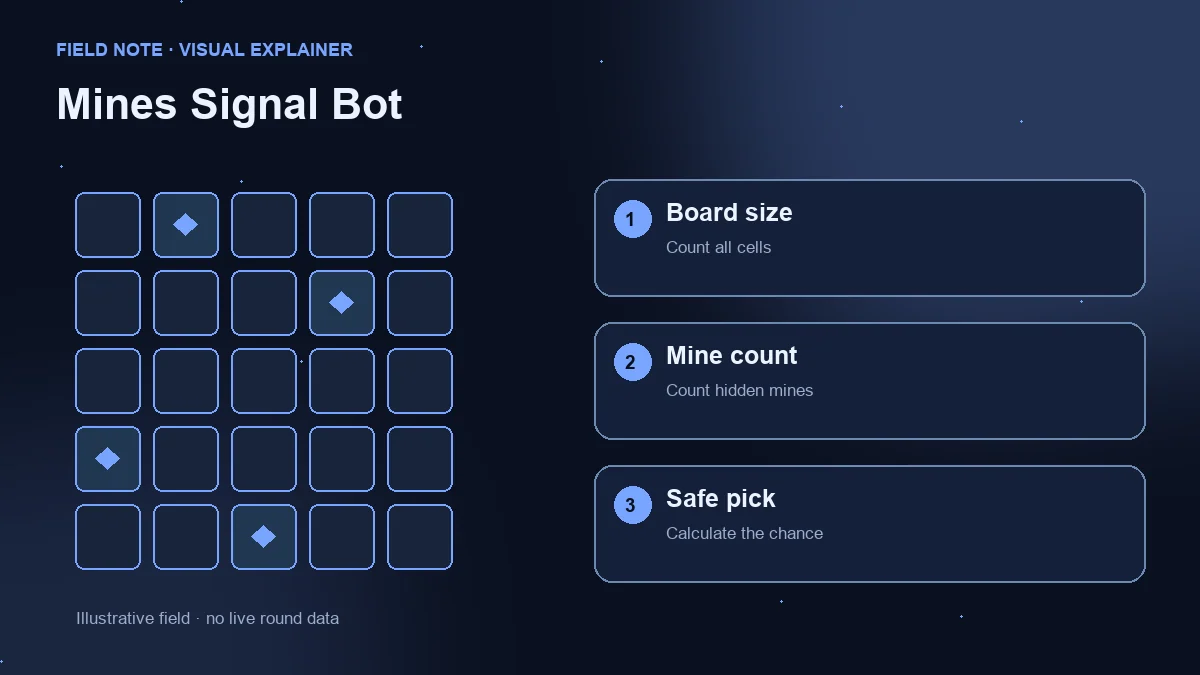
For a uniformly random fixed board before the first reveal, rows × columns gives the total cells, N. Subtracting the mines gives the safe cells, Q. The first safe-pick chance is Q/N. Picks are made without replacement: after a safe pick, there is one fewer safe cell and one fewer unopened cell.
The chance that all first k picks are safe multiplies the fractions at each step: (Q/N) × ((Q−1)/(N−1)) and so on. The chance that just the next pick is safe, given that all earlier picks were safe, uses the last fraction in that sequence. These are different questions. If a mine has already ended the round, the conditional next-pick figure does not apply.
On a five-by-five board with five mines, there are 20 safe cells among 25. The chance of one safe first pick is 20/25 = 80%. The chance of two safe picks in a row is (20/25) × (19/24) = 63.33%; after the first safe pick, the second pick alone has a 79.17% chance. The table above continues the same calculation through the third and fourth picks.
These percentages describe the model, not a bot accuracy score or the positions of safe cells in a live game. The calculation assumes a fixed number of mines distributed uniformly before the first reveal. Read the wider Mines probability guide for the assumptions behind further picks and payouts.
How to read the example grid
The grid above is one stable, illustrative arrangement for the entered settings. Its safe and mine symbols show the counts, not the positions in a live round. At each step, every unopened cell has the same chance under this model after any earlier safe picks; the highlighted symbols are not suggestions.
Changing the settings hides the old result until you calculate again. Use Reset example to return to five rows, five columns and five mines. If a particular game uses another board mechanic, the general result may not apply to it.
Scope and compatibility
This is a website tool with no casino connection, Telegram delivery or automatic betting. It does not claim compatibility with a named provider or predict a current round. The predictor method guide explains what evidence a stronger prediction claim would need. You can also browse the Mines game guides to identify the rules of a specific version.
How to use the Mines signal bot
- Enter the number of rows and columns in the board model.
- Enter the total number of mines. At least one cell must remain safe.
- Select Calculate probability to update the table and illustrative grid.
- Read the chance of an entire safe streak separately from the chance of the next pick after previous safe results.
- Use Reset example to restore the starting settings.
This Mines odds calculator uses board counts, so it does not need a casino login, client seed, deposit amount or round history. The grid settings describe a hypothetical fixed board; a row-based game such as BGaming Minesweeper needs a different model.
Supported games and delivery
This Mines signal bot does not connect to Stake, 1win or Betano, or to games by SPRIBE or JILI. An operator name and a game provider identify different things; neither establishes compatibility with this calculator. Use it only to explore a matching fixed-board model, without treating its example positions as live signals.
The tool runs on this website. There is no separate Mines signal bot app, downloadable APK or Telegram delivery offered here. A Mines predictor bot would make a different claim if it identified future safe cells; this calculator supplies probabilities, not that capability. For the differences between output types, see the Mines predictor guide.
Questions about Mines signals
Is the percentage a success rate for this bot?
No. It is a mathematical probability under the displayed assumptions. For example, 80% on a 25-cell, five-mine board is the chance of one safe random pick, not a measured prediction accuracy.
Can I follow the displayed safe cells in another game?
No. The arrangement is an illustration, independent of any casino board. Its symbols explain the counts; they are not instructions for the next click.
Editorial credits
Who wrote and edited this page

Andrew Sortie
Author credited on the English source guides and their Russian editions; this credit does not imply that he translated them.
Edward M.
English-language editor. His public Upwork profile describes iGaming copywriting across casino and sports betting.