
Editorial guide
Mines Game Probability and Multipliers Explained
A safe-pick probability answers how likely a selection is to avoid a mine. A payout multiplier answers how much a successful outcome pays. They are related, but they are not the same number.
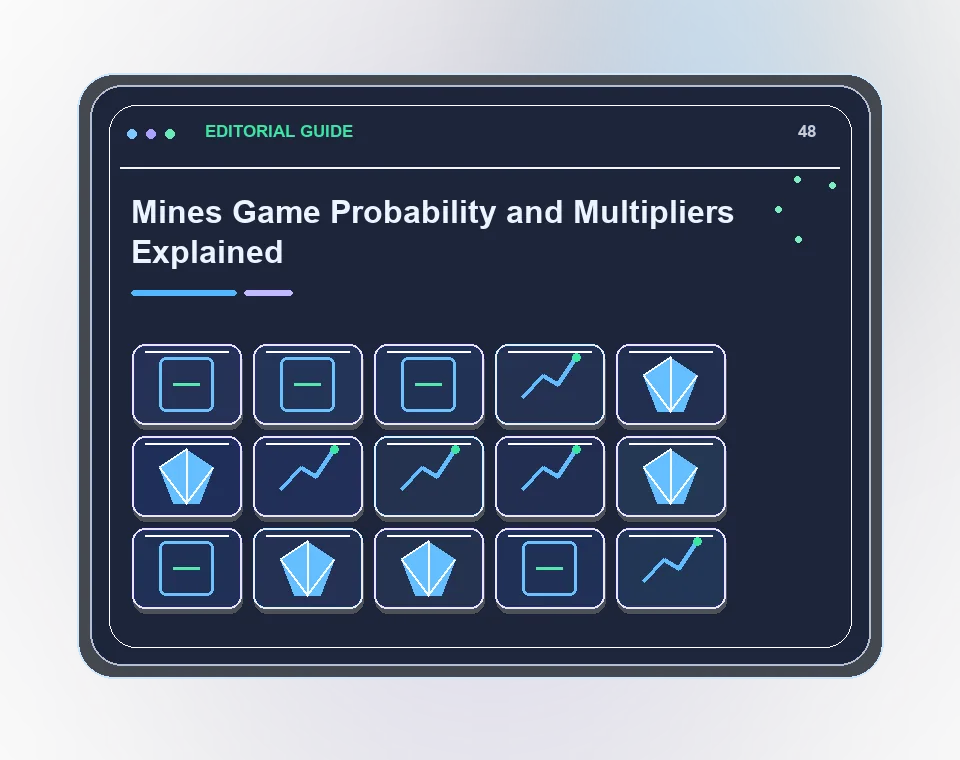
The model and its assumptions
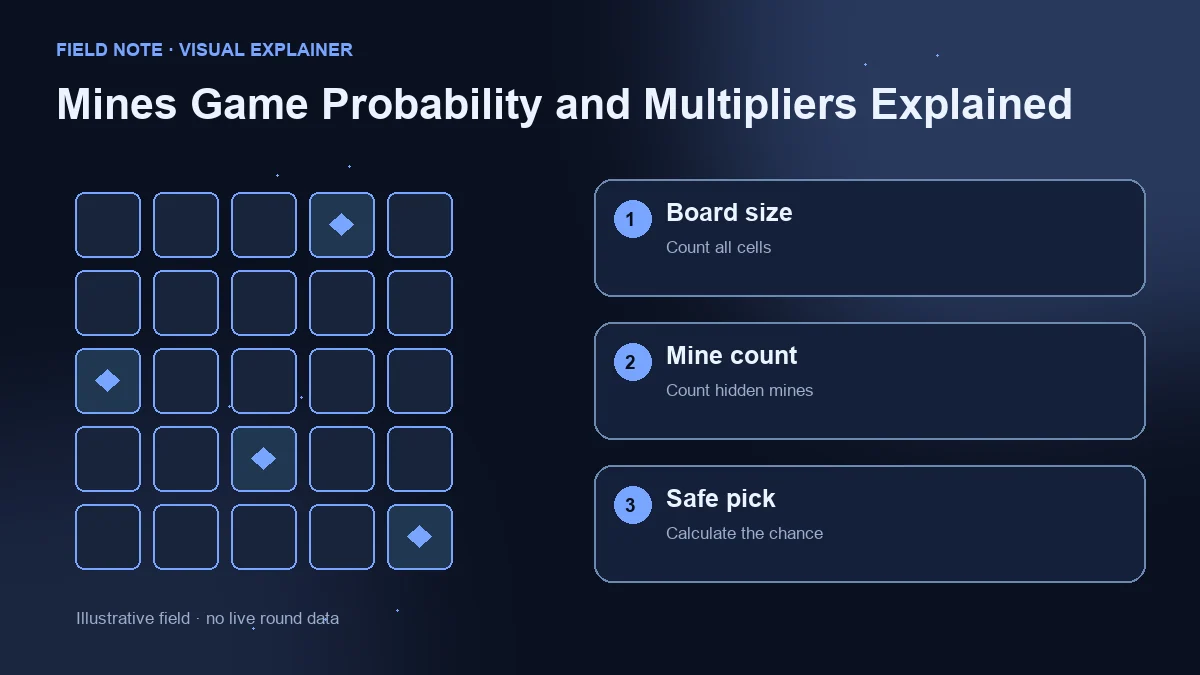
Suppose a board has N cells and M mines. The mines occupy a uniformly random set of cells, stay in place for the round, and selections reveal previously unopened cells without replacement. No additional clue distinguishes one unopened cell from another.
These assumptions describe a mathematical model. They must be checked against the game. A title with new choices at each stage, changing hazards or a bonus event may need a different calculation.
Before the first pick:
P(safe) = (N − M) / N
On a 25-cell board with five mines, that is 20/25 = 80%. It is the chance of one safe pick, not a promise that 80% of a sequence will succeed.
One next pick versus a complete run
After k successful reveals, N − k cells remain and all M mines remain hidden. The next safe-pick probability is:
P(next safe | k successes) = (N − M − k) / (N − k)
With five mines on 25 cells, the second pick is safe with probability 19/24, or about 79.17%, provided the first pick was safe.
To survive both picks from the start, multiply the conditional probabilities: 20/25 × 19/24 = 63.33%. That is a different question from the chance of the second pick alone.
For k successful picks:
P(k safe picks) = C(N − M, k) / C(N, k)
Here C(a, b) counts ways to choose b items from a. The formula applies for 0 ≤ k ≤ N − M. A run longer than the number of safe cells is impossible.
| Successful picks sought | Chance from the start, five mines in 25 cells | Fair gross multiplier |
|---|---|---|
| 1 | 80.00% | 1.2500× |
| 2 | 63.33% | 1.5789× |
| 3 | 49.57% | 2.0175× |
| 5 | 29.18% | 3.4269× |
These are calculated examples, not an operator’s payout table. Percentages and multipliers are rounded for display.
Fair odds and actual payouts
For a simplified bet that pays only when the chosen run succeeds, a fair gross multiplier is 1/P. The expected gross return is then P × (1/P) = 1 stake unit.
An actual game can apply a house margin, rounding, payout caps and bonus rules. Dividing a headline RTP by P is not a universal way to reconstruct its payout table. Use the payment rules for the exact configuration.
If the successful outcome pays a gross multiplier q and every failure pays zero, the expected gross return per unit staked is P × q. That expression needs modification if failures can still pay a separate bonus.
Payout versus profit
Gross payout includes the returned stake when the multiplier is defined that way:
Gross payout = stake × gross multiplier
Net profit = gross payout − stake
A hypothetical stake of 2 units at 1.50× returns 3 units in total, for a net profit of 1 unit. It does not produce 3 units of profit. Check whether a game label says payout, return or profit before applying the formula.
What cash-out choices change
Choosing a shorter target run increases the chance of reaching that target in this model, but its payment is usually smaller. Continuing after a success risks the current round result for a later possible award.
Whether different stopping rules have the same expected return depends on the actual payout schedule. It should not be asserted from the board model alone.
Why patterns do not identify mines
Under the stated assumptions, every unopened cell has the same conditional risk. A corner, a diagonal and the location of a mine in a previous independent round do not supply extra information about the current hidden layout.
Calculating 80% correctly does not identify twenty guaranteed safe cells. It describes uncertainty before a selection.
Mines RTP and house edge
For the simplified all-or-nothing example above, suppose a successful outcome pays a gross multiplier q and its probability is P. The expected gross return is P × q, and the corresponding house edge is 1 − P × q. Expressing either figure as a percentage requires multiplying by 100.
If P = 0.80 and q = 1.20, the expected return is 0.96 stake units and the house edge is 4%. These are hypothetical inputs, not a published Mines payout table. Bonus payments, rounding and caps can require a more complete model; a provider’s stated RTP should be matched to the exact rules.
Mines strategy, tips and winning patterns
There is no universal best Mines strategy that guarantees a win. In the stated model, a diagonal, edge or centre route has the same chance as any other sequence of distinct unopened cells of the same length. A stopping rule changes exposure and the target payout; it does not reveal a safe tile.
For a useful comparison, keep the stake and rules fixed while changing the mine count or intended number of picks. Track the probability of the whole target run, the offered return and the amount at risk separately. Increasing a stake after a loss increases exposure without improving the next tile’s probability.
These Mines tips also explain why a Minesweeper gambling strategy should not borrow the deduction rules of the classic numbered puzzle. The assumptions of the wagering game decide what information is available. For claims about how to win Mines through predictions, see the predictor evidence guide.
Calculate another example
Use the Mines calculator to compare safe-pick chances for one to four picks on a hypothetical fixed board. For actual Mines multipliers and payout limits, choose the exact game and provider; this page explains the calculation rather than supplying one universal payment schedule.
Editorial credits
Who wrote and edited this page

Andrew Sortie
Author credited on the English source guides and their Russian editions; this credit does not imply that he translated them.
Edward M.
English-language editor. His public Upwork profile describes iGaming copywriting across casino and sports betting.
From the guides
For five mines on a 25-cell board, 80% is the first-pick safety chance. After one safe reveal, 19/24 is the chance that the next pick is safe; it is not the chance of completing both picks safely from the start.