Editorial guide
Mines Predictor Methods and Limitations
Whether a Mines predictor “works” depends on what it claims to produce. A correct probability calculation, a plausible-looking grid and a successful prediction are different achievements.
Define the output first
| Output | What it can establish |
|---|---|
| Probability calculation | A chance under stated assumptions and inputs |
| Simulated grid | One generated arrangement, not necessarily the external game’s board |
| Completed-round verification | Whether saved inputs reproduce a recorded result under a protocol |
| Future-cell prediction | A testable claim about a still-hidden result |
The Mines signal bot on this site is a working probability calculator with an illustrative grid. The Mines predictor guide explains other output types. This site offers no live-board prediction service or measured prediction accuracy.
What data is available before the result?
Any prediction test must separate information available beforehand from information revealed later. A board reconstructed after a server seed is disclosed cannot be counted as a successful advance prediction.
For example, Stake’s documented process uses a server seed as well as a client seed and round information. Supplying only the client seed does not reproduce the calculation that requires the undisclosed server seed. This observation concerns that protocol, not every product called Mines. Stake implementation.
Compare accuracy with the right baseline
On a uniformly random 25-cell board with one mine, a single blind selection is already safe with probability 24/25 = 96%. A claimed 95% safe-pick rate would not, by itself, demonstrate an improvement over that baseline.
With five mines, the first-pick baseline is 80%. After successful reveals it changes because fewer safe cells remain. Results across different mine counts and stages should not be pooled without accounting for those differences.
Whole-board accuracy, one-cell accuracy and the chance of completing a run are also different measures. A claim must specify which one was measured.
What a useful test would record
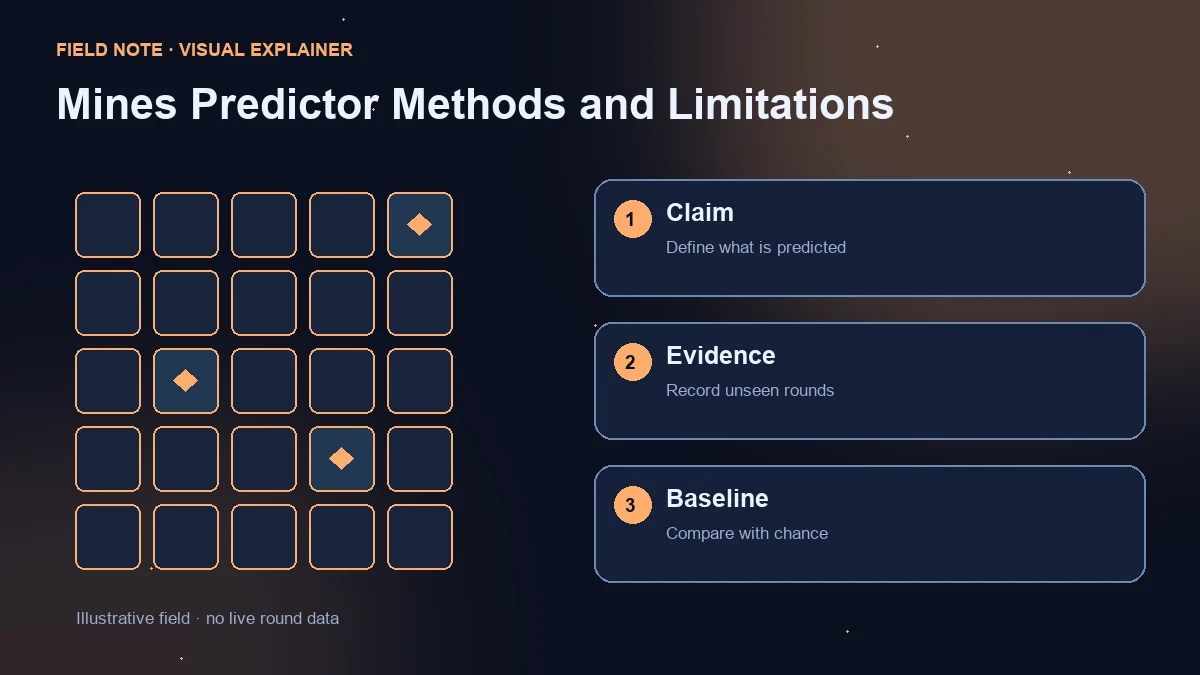
A reproducible evaluation needs predictions saved before outcomes are known, the exact game and settings, all eligible trials, failures as well as successes, and any cases where the tool declined to answer. It also needs a defined comparison method and an indication of statistical uncertainty.
Testing on rounds already used to build a method does not establish how it performs on new rounds. A screenshot of a successful series cannot replace the full record.
Even a higher safe-pick rate would need to be evaluated against actual payouts and costs before making a claim about returns.
Questions to ask before trusting a predictor
Ask which exact game is supported, what the highlighted cells represent, and how the method obtains information before the result. Request the complete test record rather than selected winning screenshots. If those answers are missing, there is no basis for treating an accuracy percentage, an AI label or a guaranteed-safe claim as evidence.
For a probability tool, check the formula and assumptions instead. A calculator can be mathematically correct while having no information about hidden cell positions.
Do Mines predictors work?
A probability calculator can work correctly without predicting a single hidden cell. A completed-round verifier can reproduce a result after the required data is revealed. Neither achievement demonstrates a working future-cell predictor. The calculator on this site makes no live prediction claim; its example grid is independent of casino outcomes.
Can Mines be predicted from a pattern?
Under the uniformly random fixed-board model, no unopened cell is distinguished by a remembered shape or a previous independent round. To claim an exception, a method needs relevant information available before the outcome and reproducible evidence of an advantage over chance.
Are Mines signals legit, and what about a Mines hack?
The label alone is not evidence. A Mines signal may be a calculated probability, an illustrative cell selection or a claimed forecast. Check which one is actually delivered. An app calling itself a Mines predictor hack has not demonstrated access to hidden game data by using that name. This site does not provide a game exploit or a hidden-board reader.
What does Mines predictor accuracy mean?
It must specify the target: one safe pick, every cell on a board or a full run. A useful result also gives the mine count, sample size, failed trials and comparison baseline. Without those details, a percentage cannot establish predictive value.
Editorial credits
Who wrote and edited this page

Andrew Sortie
Author credited on the English source guides and their Russian editions; this credit does not imply that he translated them.
Edward M.
English-language editor. His public Upwork profile describes iGaming copywriting across casino and sports betting.