Editorial guide
Stake Mines Predictor
A Stake Mines predictor that asks only for a client seed cannot reproduce Stake’s documented outcome calculation: the calculation also needs the server seed and round inputs. This page explains what those inputs establish, how completed-round verification differs from prediction, and which tools you can use here.
Why a client seed is not enough
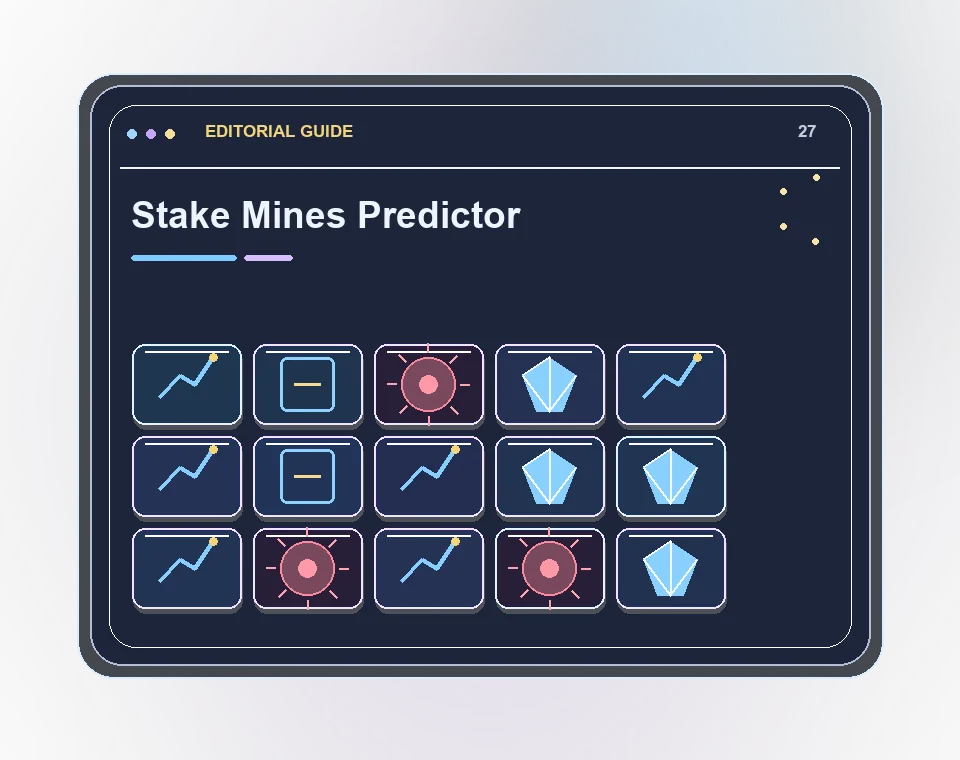
Stake’s implementation reference documents a calculation using the server seed, client seed, nonce and cursor. Before play, the player receives a hash commitment to the server seed. The original seed is disclosed after rotation.
A hash commitment is not a substitute for the original server seed in that calculation. Entering a client seed, mine count and stake into a form therefore does not demonstrate access to the hidden board. A claimed predictor must explain its additional information and when it becomes available.
Verification and compatibility
Completed-round verification checks a recorded outcome after the necessary inputs are available. Keep the original commitment, client seed, nonce and game settings; use the revealed server seed with the correct event mapping. A matching result concerns that recorded round.
Stake Originals Mines and third-party Mines games in Stake’s catalogue are separate products. The Originals documentation should not be applied automatically to BGaming Minesweeper or another provider’s title. The Stake game guide separates those catalogue entries.
Stake Mines predictor setup and limitations
This site does not offer a Stake account connection, predictor download or safe-cell overlay. You can use the Mines odds calculator without an account:
- Enter the rows, columns and mine count for the fixed-board model you want to explore.
- Select Calculate probability.
- Read the cumulative chance of one to four safe picks separately from the chance of the next pick after earlier safe reveals.
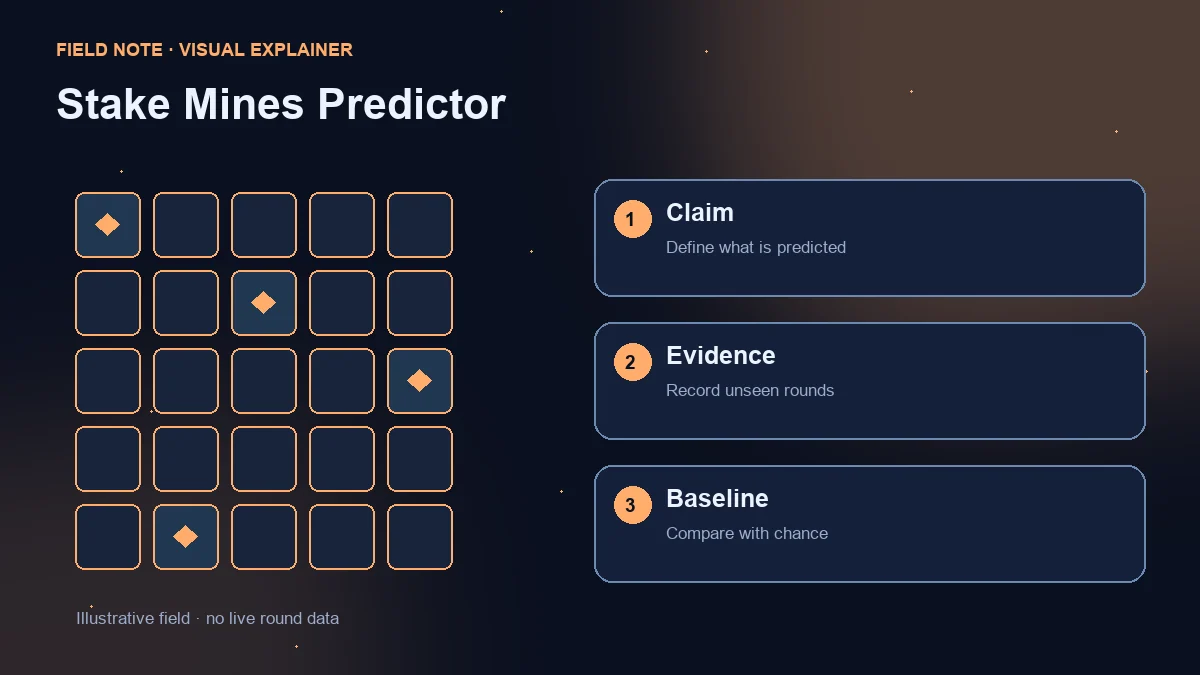
- Treat the grid as an illustration. Do not copy its highlighted positions into Stake.
For a 25-cell board with five mines, a random first pick is safe with probability 80%. Two safe picks from the start have probability 63.33%; after the first safe reveal, the second pick alone has probability 79.17%. These are model probabilities, not measured predictor success rates or payout multipliers.
The provably fair Mines guide walks through a synthetic verification example. It explains the calculation without claiming to inspect your account history.
Does a successful screenshot prove a predictor works?
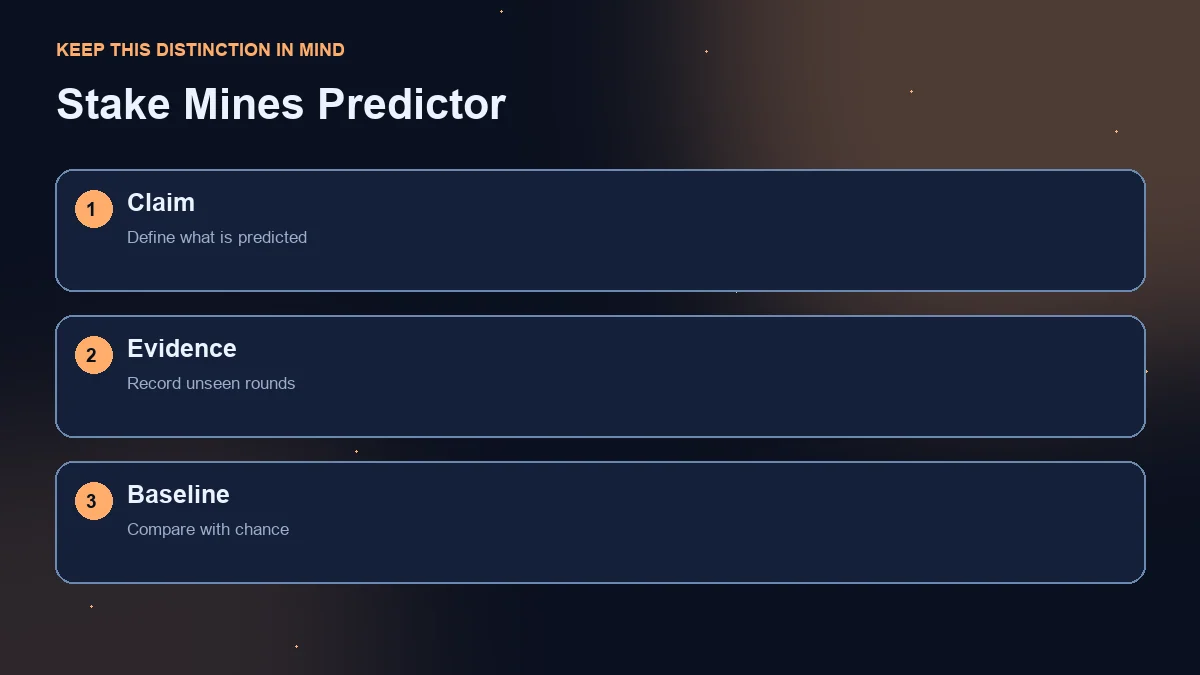
No. A useful accuracy claim needs predictions recorded before the result, the exact settings, every eligible trial including failures, and comparison with chance. A reconstructed board displayed after seed disclosure is not an advance prediction.
Changing a client seed changes an input; it does not reveal which cells will be safe. Repeating a shape from an independent earlier round also supplies no positional information under the uniformly random board model. Read the predictor testing method before interpreting claims about patterns or accuracy.
Editorial credits
Who wrote and edited this page
Andrew Sortie
Author credited on the English source guides and their Russian editions; this credit does not imply that he translated them.
Edward M.
English-language editor. His public Upwork profile describes iGaming copywriting across casino and sports betting.